A Comparative Study of Thailand’s Eastern Aerotropolis and the Aerotropolis Model
Keywords:
Aerotropolis, Eastern Aerotropolis, Aerotropolis ModelAbstract
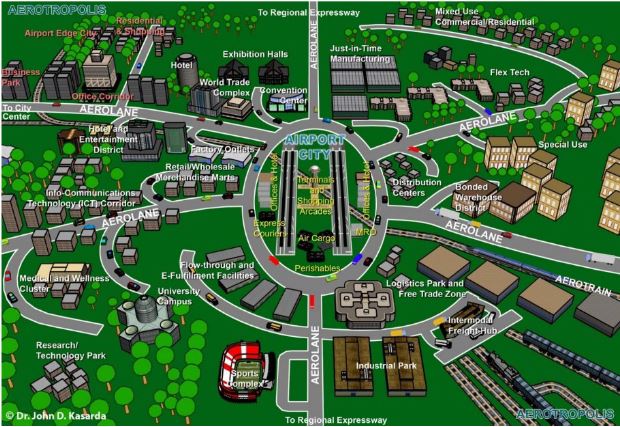
This research aims to 1) conduct a comparative study of Thailand’s Eastern Aerotropolis and The Aerotropolis Model and 2) provide development guidelines for the Eastern Aerotropolis. The study emphasizes structural analysis in terms of infrastructure, transportation systems, business zones, industrial areas, and logistics hubs to identify key success factors and challenges for aerotropolis development in the Thai context. The research examined and compared the Zhengzhou Aerotropolis in China with the Eastern Aerotropolis in Thailand across nine key dimensions: 1) airport connectivity with surrounding areas, 2) aircraft maintenance zones, 3) industrial zones, 4) logistics and cargo business hubs, 5) commercial business zones, 6) residential areas, 7) technology innovation zones, 8) educational zones, and 9) healthcare zones. This study employed a qualitative research approach using documentary research methods. Data were gathered from primary and secondary sources, and a comparative data synthesis was conducted based on internationally recognized aerotropolis city development frameworks.
The findings revealed that the Eastern Aerotropolis in Thailand made progress in transportation infrastructure and logistics systems, particularly in multimodal transportation connectivity and designated zones for business and specialized industries. However, limitations remained in several areas, including the capacity of the aircraft maintenance industry, the shortage of highly skilled labor, and the need for greater investment in advanced technology and innovation. These findings can serve as a foundation for policy recommendations to enhance the competitiveness of the Eastern Aerotropolis at an international level. Key policy directions should include national-level strategic planning, government support, private sector investment incentives, modern infrastructure development, and strengthened international collaborations. Future research should explore urban management strategies and the economic and social impacts of aerotropolis development to ensure balanced and sustainable growth.
References
สำนักงานการบินพลเรือนแห่งประเทศไทย, “รายงานสภาวะอุตสาหกรรมการบินของประเทศไทย พ.ศ. 2561,” [ออนไลน์]. เว็บไซต์: https://www.caat.or.th/wp-content/uploads/2019/05/รายงานสภาวะอุตสาหกรรมการบินของประเทศไทย-พ.ศ.-2561-ฉบับปรับปรุง-ณ-วันที่-17-พฤษภาคม-2562.pdf. (เข้าถึงเมื่อ: 2 มกราคม 2567).
สำนักงานเศรษฐกิจอุตสาหกรรม, “แผนยุทธศาสตร์ประจำปี พ.ศ. 2560-2565,” [ออนไลน์]. เว็บไซต์: https://www.oie.go.th/assets/portals/1/fileups/2/files/action%20plan/oie_strategy_2017_2021.pdf. (เข้าถึงเมื่อ: 2 มกราคม 2567).
J. D. Kasarda and G. Lindsay, Aerotropolis: The Way We’ll Live Next, New York: Macmillan, 2011.
J. D. Kasarda, “China’s Aerotropolis: The Zhengzhou Airport Economy Zone.” [Online]. Available: https://www.internationalairportreview.com/whitepaper/73497/chinas-aerotropolis-airport-economy/. (Accessed: January. 2, 2024).
ลัฐกา เนตรทัศน์, “การส่งเสริมให้ประเทศไทยเป็นศูนย์กลางการบินของอาเซียน,” [ออนไลน์]. เว็บไซต์: https://www.lawforasean.krisdika.go.th/File/files/Article_May2_AviationHub.pdf. (เข้าถึงเมื่อ: 2 มกราคม 2567).
R. Banai, “The aerotropolis: Urban sustainability perspectives from the regional city,” The Journal of Transport and Land Use, vol. 10, no. 1, pp. 357-373, December 2016.
J. D. Kasarda and S. J. Appold, “Planning a competitive aerotropolis,” The Economics of International Airline Transport, vol. 4, pp. 281-308, August 2014.
B. Huo and M. Guo, “How does an aerotropolis integrate? A case from Zhengzhou Airport Economy Zone,” MDPI- Multidisciplinary Digital Publishing Institute, vol 5, no. 2, pp. 1-16, May 2021.
S. J. Appold and J. D. Kasarda, “The airport city phenomenon: evidence from large US airports,” Urban Studies, vol. 50, no. 6, pp. 1239–1259, May 2013.
P. Pujinda, “The Competitiveness of Airport Regions in Southeast Asia: The Lesson from Two Arch Rivals in Europe,” Journal of Environmental Design and Planning, vol 2, no. 1, pp. 69-80, January 2007.
C. Bejrananda, “From Runway to Cityscape: Challenges of Airport-Driven Urban Growth,” International Journal of Building, Urban, Interior and Landscape Technology, vol. 22, no. 2, pp. 1-10, December 2024.
พนิดา งามจรัสศรีวิชัย และ กมลพร กัลยาณมิตร, “การนำโครงการพัฒนาระเบียงเศรษฐกิจพิเศษภาคตะวันออก (EEC) ไปปฏิบัติ,” วารสารวิชาการ สถาบันวิทยาการจัดการแห่งแปซิฟิค, ปีที่ 6, ฉบับที่ 2, หน้า 323-333, พฤษภาคม-สิงหาคม, 2563.
นพดล วิยาภรณ์ และ เอกพร รักความสุข, “การบริหารการพัฒนาโครงการพื้นที่เขตเศรษฐกิจพิเศษ ศึกษากรณี: พื้นที่เขตเศรษฐกิจพิเศษภาคตะวันออก EEC,” วารสารมหาจุฬาวิชาการ, ปีที่ 6, ฉบับที่ 2, หน้า 95-109, กรกฎาคม-ธันวาคม, 2562.
G. A. Bowen, “Document analysis as a qualitative research method,” Qualitative Research Journal, vol. 9, no. 2, pp. 27–40, August 2009.
T. L. Wheelen, J. D. Hunger, A. N. Hoffman and C. E. Bamford, Strategic Management and Business Policy, London: Pearson, 2017.
สำนักงานคณะกรรมการนโยบายเขตพัฒนาพิเศษภาคตะวันออก (สกพอ.), “แผนปฏิบัติการโครงสร้างพื้นฐานและสาธารณูปโภคในพื้นที่เขตพัฒนาพิเศษ ภาคตะวันออก พ.ศ. 2566-2570,” [ออนไลน์]. เว็บไซต์: https://www.eeco.or.th/web-upload/filecenter/eec-development-plan/plan.pdf (เข้าถึงเมื่อ: 2 มกราคม 2567).
ไทยพับลิก้า, “เปิดสัมปทาน ศูนย์ซ่อมบำรุงอากาศยาน” มิ.ย. 65 ยก “อู่ตะเภา” สู่มหานครการบินครบวงจร,” [ออนไลน์]. เว็บไซต์: https://thaipublica.org/2021/12/u-tapao-aviation-technical-zone/ (เข้าถึงเมื่อ: 2 มกราคม 2567).
จันทร์จิรา ปาโท และ ญาเรศ อัครพัฒนานุกูล, “6 อุตสาหกรรมหลัก เป้าหมายการพัฒนาเขตนวัตกรรม ระเบียงเศรษฐกิจพิเศษภาคตะวันออก (EECi),” Journal of Modern Learning Development, ปีที่ 7 ฉบับที่ 6, หน้า 377-393, กรกฎาคม, 2565.
สำนักงานคณะกรรมการนโยบายเขตพัฒนาพิเศษภาคตะวันออก (สกพอ.), “แผนปฏิบัติการด้านโครงสร้างพื้นฐานศูนย์ธุรกิจ EEC และเมืองใหม่น่าอยู่อัจฉริยะ,” [ออนไลน์]. เว็บไซต์: https://www.eeco.or.th/web-upload/filecenter/eec-new-city/eec-new-city-004.pdf (เข้าถึงเมื่อ: 2 มกราคม 2567).
หรรษธร ณรงค์, วิจิตรา ศรีสอน และ สัณฐาน ชยนนท์, “ยุทธศาสตร์การพัฒนาระเบียงเศรษฐกิจภาคตะวันออก (EEC),” วารสารสันติศึกษาปริทรรศน์ มจร, ปีที่ 10, ฉบับที่ 3, หน้า 1256-1267, พฤษภาคม, 2022
สำนักงานคณะกรรมการนโยบายเขตพัฒนาพิเศษภาคตะวันออก (สกพอ.), “แผนปฏิบัติการการพัฒนาบุคลากร การศึกษา การวิจัย และเทคโนโลยี รองรับการพัฒนาเขตพัฒนาพิเศษภาคตะวันออก,” [ออนไลน์]. เว็บไซต์: https://www.eeco.or.th/web-upload/filecenter/untitled%20folder/EEC013.pdf (เข้าถึงเมื่อ: 2 มกราคม 2567).
Downloads
Published
How to Cite
Issue
Section
Categories
License
Copyright (c) 2025 NKRAFA JOURNAL OF SCIENCE AND TECHNOLOGY

This work is licensed under a Creative Commons Attribution-NonCommercial-NoDerivatives 4.0 International License.
- Content and information in articles published in NKRAFA Journal of Science and Technology are comment and responsibility of authors of articles directly. Journal editorial do no need to agree or share any responsibility.
- NKRAFA Journal of Science and Technology Articles holds the copyright of the content, pictures, images etc. which published in it. If any person or agency require to reuse all or some part of articles, the permission must be obtained from the NKRAFA Journal of Science and Technology.