
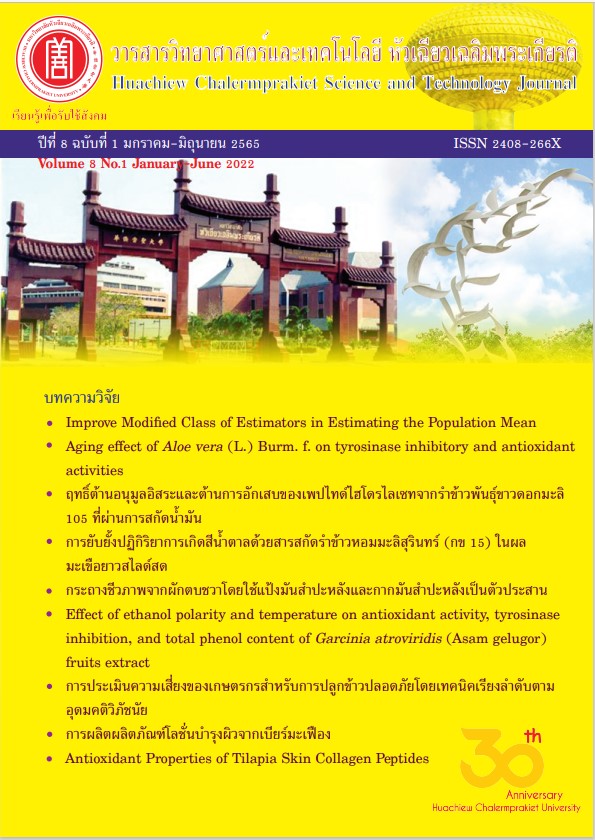
Aging effect of Aloe vera on the tyrosinase inhibition and antioxidant activities
Keywords:
Aloe vera, tyrosinase inhibitory, Antioxidant activities contentsAbstract
Aloe vera extract is an essential ingredient in a wide variety of cosmetic products. This research compares the antioxidant effects and tyrosinase inhibitors of the A. vera extracted from leaves at different stages. The results could be applied in arranging the A. vera leaf into grades for the cosmetic field. In this study, three stages of A. vera leaf: A1 (4-6 months), A2 (7-9 months), and A3 (10-12 months) were divided. The results showed that the water content of the A. vera leaf at A1, A2, and A3 were 98.00 ± 0.02, 97.10 ± 0.02, and 96.00 ±0.04, respectively. In the extraction processes, the A. vera leaf samples were peeled and rinsed with deionized water. After the A. vera gel was blended thoroughly and freeze-dried, A. vera powder was obtained. The A. vera powder was extracted with 80% v/v methanol and dried volatilized by pressure reduction technique. The extract yields of all three stages (A1-A3) was 24.97 ± 0.28, 35.27 ± 0.70, and 32.20 ± 0.29, respectively. The methanol crude extracts examined the antioxidant activity using DPPH and ABTS techniques with Trolox as the standard. The samples (A1-A3) and standard Trolox showed the antioxidant activity against the DPPH radical in terms of percent inhibition at 41.76 ± 0.57%, 40.72 ±2.31%, 37.01 ± 2.22%, and 49.90 ± 1.74%, respectively. The samples (A1-A3) and standard Trolox showed the antioxidant activity against the ABTS•+ radical in term of percent inhibition at 13.65 ± 3.44%, 53.02 ± 1.16%, 13.85 ± 1.08%, and 74.88 ±2.15%, respectively. Among three A. vera extracts, the A2 stage showed the highest antioxidant activity derived from the ABTS technique. Tyrosinase inhibition of A. veraextracts (A1-A3) was investigated and compared with standardized kojic acid at the concentration of 50 ug/mL. It was found that the A. vera extracted at the A2 stage showed the highest tyrosinase inhibition at 18.68 ± 0.99%, while the A. vera A1, A2 stages and the kojic acid showed tyrosinase inhibition at 17.93 ± 0.80%, 15.74 ± 1.17%, and 13.03 ± 0.96%, respectively. The results showed that 7-9 months growth periods of A. vera were an antioxidant activity and tyrosinase inhibition of the gel-extracts suitable for cosmetic application.
References
Spencer D, Rachel O, Linli Z, Liyuan J, Yuhang Z, Kadekaro L. Natural antioxidants: Multiple mechanisms to protect skin from solar radiation. Front Pharmacol 2018;24(9):1163–9812.
Martinez AT, Ortiz RC, Flores MEJ, Diaz PO, Reyes SVA, Jasso GMA, et al. In vitro fermentation of polysaccharides from Aloe vera and the evaluation of antioxidant activity and production of short chain fatty acids. Molecules 2019;24(19):3605–25.
Gupta SD, Masakapalli SK. Mushroom tyrosinase inhibition activity of Aloe vera L. gel from different germplasms. Chin J Nat Med 2013;11(6):616–20.
Yagi A, Kanbara T, Morinobu N. Inhibition of mushroom-tyrosinase by Aloe extract. Planta Med 1987;53(6):515–7.
Choi S, Lee SK, Kim J-E, Chung M-H, Park Y-I. Aloesin inhibits hyperpigmentation induced by UV radiation. Clin Exp Dermatol 2002;27(6):513–5.
Jones K, Hughes J, Hong M, Jia Q, Orndorff S. Modulation of melanogenesis by aloesin: A competitive inhibitor of tyrosinase. Pigment Cell Res 2002;15(5):335–40.
Surjushe A, Vasani R, Saple DG. Aloe vera: A short review. Indian J Dermatol 2008;53(4):163–6.
Hamman JH. Composition and applications of Aloe vera leaf gel. Molecules 2008;13(8):1599–616.
Hekmatpou D, Mehrabi F, Kobra R, Atefeh A. The effect of Aloe vera clinical trials on prevention and healing of skin wound: A systematic review. Iran J Med Sci 2019;44(1):1–9.
Lee S, Do SG, Kim SY, Kim J, Jin Y, Lee CH. Mass spectrometry-based metabolite profiling and antioxidant activity of Aloe vera (Aloe barbadensis Miller) in different growth stages. J Agric Food Chem 2012;60(65):11222–8.
Ray A, Gupta SD, Ghosh S. Evaluation of anti-oxidative activity and UV absorption potential of the extracts of Aloe vera L. gel from different growth periods of plants. Ind Crops Prod 2013;49:712–9.
Ray A, Ghosh S. Chemometrics for functional group distribution, and UV Absorption potential of Aloe vera L. Gel at different growth periods. Mater Today Proc 2018;5(10):22245–53.
Oliveira AS, Cercato LM, Souza MTS, Melo AJO, Lima BS, Duarte MC, et al. The ethanol extract of Leonurus sibiricus L. induces antioxidant, antinociceptive and topical anti-inflammatory effects. J Ethnopharmacol 2017;206:144–51.
Yu LL, Hu WC, Ding G, Li RT, Wei JH, Zou ZM, et al. Gusanlungionosides A-D, Potentil tyrosinase inhibitors from Arcangelisia gusanlung. J Nat Prod 2011;74(9):1009–14.
Femenia A, Sánchez ESS, Simal S, Rosselló C. Compositional features of polysaccharides from Aloe vera (Aloe barbadensis Miller) plant tissues. Carbohydr Polym 1999;39(2):109-17.
Eshun K, He Q. Aloe Vera: A valuable ingredient for the food, Pharmaceutical and Cosmetic Industries—A Review. Crit Rev Food Sci Nutr 2010;44(2):91–6.
Downloads
Published
How to Cite
Issue
Section
License
Copyright (c) 2022 Huachiew Chalermprakiet Science and Technology Journal

This work is licensed under a Creative Commons Attribution-NonCommercial-NoDerivatives 4.0 International License.
บทความทุกบทความที่ได้รับการตีพิมพ์ถือเป็นลิขสิทธิ์ของ คณะวิทยาศาสตร์แฟละเทคโนโลยี มหาวิทยาลัยหัวเฉียวเฉลิมพระเกียรติ

