
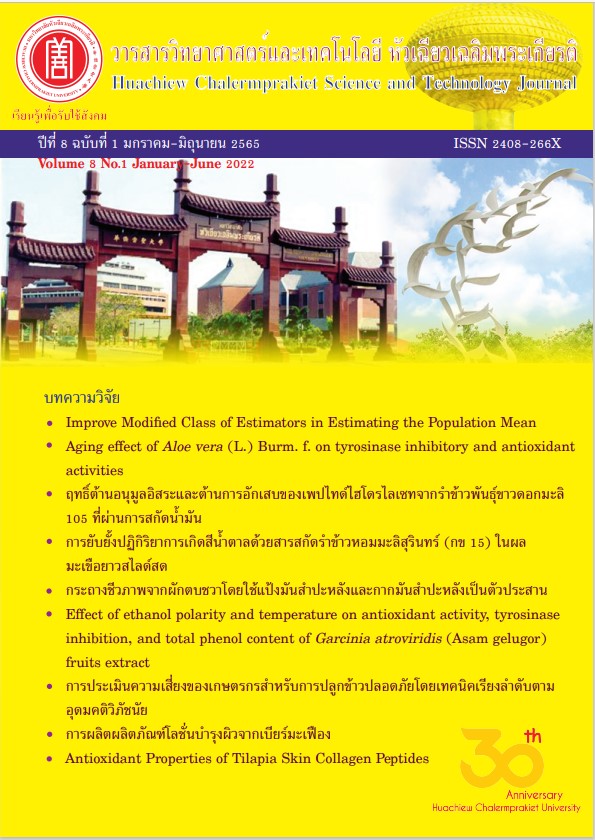
Production of body lotion from star fruit beer
Keywords:
Star fruit beer, Total phenolic contents, Lotion body, AntioxidantAbstract
The objective of this research was to study the production of skincare lotion products from star fruit beer and analyze its physical, chemical and microbiological properties. Three formulations of body lotions were studied: control lotion, ale beer lotion and star fruit beer lotion to evaluate physical properties by considering the lotion such as lotion texture, color and smell. It was found that in the analysis of the antioxidant activity by the method 2,2-diphenyl-1-picrylhydrazyl (DPPH) a star fruit beer lotion showed the highest antioxidant rate at 51.80%, followed by ale beer lotion at 37.41% and the least was the control lotion with an inhibitory rate only 20.80% free radicals. In total phenolic compounds assays by Folin-Ciocalteu indicated that star fruit beer lotion had the highest total content of phenolic compounds followed by ale beer lotion and control lotion which have total phenolic compounds of 2,158.1, 1,921.9, and 1,194.2 micrograms of gallic acid per milliliter respectively, and from the 3 formulations of body lotions for microbiological analysis, i.e. the total number of bacteria, yeast and fungi aerobic and pathogenic microorganisms, namely Staphylococcus aureus, Pseudomonas aeruginosa, Candida albicans and Clostridium spp. The total number of aerobic bacteria, yeast and fungi in the three lotion formulations was < 10 CFU/g and no contamination of all 4 pathogenic microorganisms was found.
References
Giacosa A, Barale R, Bavaresco L, Faliva MA, Gerbi V, Vecchia C, Negri E, Opizzi A, Perna S, Pezzotti M, Rondanelli M. Mediterranean way of drinking and longevity. Crit Rev Food Sci Nutr 2016;56(4):635-40.
Zapata P, Esplá A, Vilaplana A, Lax D, Artiaga L, Barrachina A. Phenolic, volatile and sensory profiles of beer enriched by macerating quince fruits. LWT Food Sci Technol 2019;103:139-46.
Sierksma A, Kok FJ. Beer and health: from myths to science. Eur J Clin Nutr 2012;66:869-70.
Nardini M, Garaguso I. Characterization of bioactive compounds and antioxidant activity of fruit beers. Food Chem 2020;305:125437.
Michalek IM, John SM, Santos FL. Microbiological contamination of cosmetic products-observations from Europe, 2005–2018. J Eur Acad Dermatol Venereol 2019;33(11):2151-7.
Parvez S, Kang M, Chung SH, Cho C, Hong CM, Shin KM, Bae H. Survey and mechanism of skin depigmenting and lightening agents. Phytother Res 2006;20(11):921-34.
Valim F, Oliveira EA, Kamimura ES, Alves AD, Maldonado RR. Production of star fruit alcoholic fermented beverage. Indian J Microbiol 2016;56(4):476–81.
เสาวนีย์ กระสานติสุข, หทัยชนก รุณรงค์. การพัฒนาตำรับโลชั่นบำรุงผิว. วิทยานิพนธ์ปริญญาเภสัชศาสตรบัณฑิต คณะเภสัชศาสตร์, มหาวิทยาลัยมหิดล. กรุงเทพฯ; 2549.
สุรพงศ์ รัตนะ, บรรลือ สังข์ทอง. ฤทธิ์ต้านอนุมูลอิสระ ปริมาณฟีนอลิก และปริมาณฟลาโวนอยด์ของสารสกัดคัดเค้า (Oxyceros horridus). วารสารหมอยาไทยวิจัย 2563;6(2):1-10.
สุนันทา ข้องสาย, ลักษมี วิทยา. สารประกอบฟีนอลิก สารประกอบฟลาโวนอยด์ และฤทธิ์ต้านอนุมูลอิสระของสารสกัดจากเสม็ดขาวและเสม็ดแดง. ใน: เอกสารประกอบการประชุมวิชาการ The 15th International Conference on Multi-functional Materials and Applications (ICMMA 2021) ครั้งที่ 15 วันที่ 25 พฤศจิกายน 2564. มหาวิทยาลัยเทคโนโลยีราชมงคลศรีวิชัย. ตรัง; 2562. หน้า 16-21.
ตมิสา จันทวงศ์, เตชินี เผ่าผาง, ธีริศรา โพธิ์ทองมา, มงคล เพ็ญสายใจ. การพัฒนาผลิตภัณฑทําความสะอาดเสนผมและหนังศีรษะจากเบียรเชอรรี่. วารสาร มรภ.สข. วิชาการ 2564;2(1):23-32.
BAM. Bacteriological Analytical Manual–Chapter 23: Microbiological Methods for Cosmetics. [Internet].2017 [cited 2022 February 2]. Available from: http://www.fda.gov.com
Pauline M, Alexandre O, Andoseh B, Tetmoun M, Abeline S, Agatha T. Production technique and sensory evaluation of traditional alcoholic beverage based maize and banana. Int J Gastron Food Sci 2017;10:11-5.
Yoshida S, Yokoyama A. Identification and characterization of genes related to the production of organic acid in yeast. J Biosci Bioeng 2012;113:556-61.
Wei SD, Chen H, Yan T, Lin YM, Zhou HC. Identification of antioxidant components and fatty acid profiles of the leaves and fruits from Averrhoa carambola. LWT Food Sci Technol 2014;55:278-85.
Tronina T, Poplonski J, Bartmanska A. Flavonoids as phytoestrogenic components of hops and beer review. Mol 2020;25(18):4201.
Leong LP, Shui G. An investigation of antioxidant capacity of fruits in Singapore markets. Food Chem 2002;76:69-75.
Lim YY, Lim TT, Tee JJ. Antioxidant properties of tropical fruits: a comparable study. Food Chem 2007;103(3):1003-8.
Lovett PN. Shea butter: Properties and processing for use in food. Specialty Oils and Fats in Food and Nutrition. 1st ed. UK : Woodhead Publishing; 2015.
Kubola J, Siriamompun S, Meeso N. Phytochemical, vitamin C and sugar content of Thai wild fruits. Food Chem 2011;126:972-81.
Starkel P, Saeger CD, Delire B, Magat J, Jordan B, Konda VR, Tripp ML, Borbath I. Tetrahydro iso-alpha acids and hexahydro iso-alpha acids from hops inhibit proliferation of human hepatocarcinoma cell lines and reduce diethylnitrosamine induced liver tumor formation in rats. Nutr Cancer 2015;67(5):748-60.
Nowak K, Wrona WR, Gorska M, Jablonska E. Parabens and their effects on the endocrine system. Mol Cell Endocrinol 2018;(474):238-51.
สำนักงานมาตรฐานผลิตภัณฑ์อุตสาหกรรม. มาตรฐานอุตสาหกรรมเอส : ผลิตภัณฑ์บำรุงผิวผสมสมุนไพร. [อินเตอร์เน็ต]. 2562 [เข้าถึงเมื่อ 6 มี.ค. 2565]. เข้าถึงได้จาก: https://www.tisi.go.th/assets/website/pdf/tiss/15-2562.pdf
Downloads
Published
How to Cite
Issue
Section
License
Copyright (c) 2022 Huachiew Chalermprakiet Science and Technology Journal

This work is licensed under a Creative Commons Attribution-NonCommercial-NoDerivatives 4.0 International License.
บทความทุกบทความที่ได้รับการตีพิมพ์ถือเป็นลิขสิทธิ์ของ คณะวิทยาศาสตร์แฟละเทคโนโลยี มหาวิทยาลัยหัวเฉียวเฉลิมพระเกียรติ

