Landscape Genes and Spatial Configuration in a Traditional Village: An Angular Space Syntax Analysis of San-Qing Village, China
DOI:
https://doi.org/10.56261/built.v24.263535Keywords:
traditional village, landscape genes, angular space syntax, spatial configuration, cultural landscapeAbstract
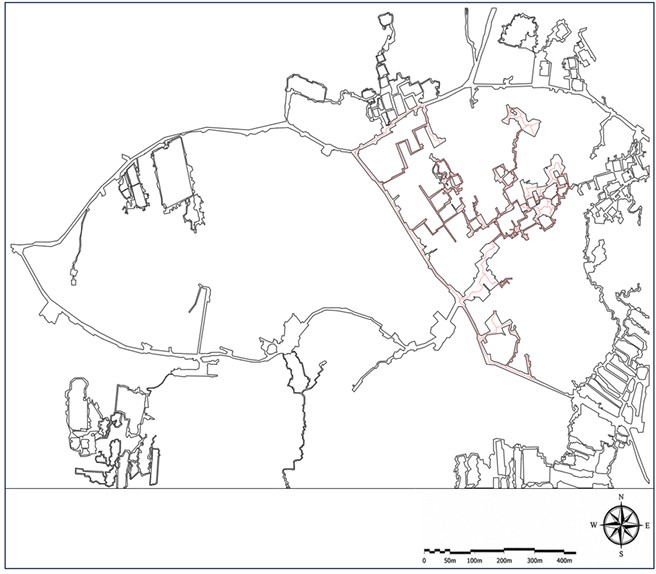
Traditional villages preserve cultural identity and spatial memory through long-term interactions among environmental conditions, social organization, and settlement evolution. However, existing landscape gene studies have primarily focused on the identification and preservation of physical cultural elements, while the configurational mechanisms underlying their organization remain insufficiently explored. This study integrates landscape gene theory with angular space syntax to investigate the relationship between landscape genes and spatial configuration in San-Qing Village, Hainan, China. Based on field surveys, spatial mapping, and segment-based analysis in Depthmap, angular connectivity, integration, choice, and synergy analyses were employed to examine accessibility, movement patterns, and spatial hierarchy within the village circulation system. The results reveal a hierarchical and partially centralized circulation structure in which highly integrated and high-choice routes function as the principal movement corridors. Synergy analysis indicates a moderate relationship between local and global accessibility (R² = 0.255394), while representative landscape gene elements, including ritual and communal spaces, are concentrated along highly accessible and structurally significant routes. These findings demonstrate that angular space syntax provides an effective framework for interpreting the configurational characteristics of traditional village landscape genes and offers practical implications for heritage conservation and sustainable village revitalization
Downloads
References
Cao, K., Liu, Y., Cao, Y., Wang, J., & Tian, Y. (2024). Construction and characteristic analysis of landscape gene maps of traditional villages along ancient Qin-Shu roads, Western China. Heritage Science, 12, Article 37. https://doi.org/10.1186/s40494-024-01155-y
Chen, X., Xie, W., & Li, H. (2020). The spatial evolution process, characteristics and driving factors of traditional villages from the perspective of the cultural ecosystem: A case study of Chengkan Village. Habitat International,104,102250. https://doi.org/10.1016/j.habitatint.2020.102250
Dastgerdi, A. S., Sargolini, M., Broussard Allred, S., Chatrchyan, A., & De Luca, G. (2020). Climate change and sustaining heritage resources: A framework for boosting cultural and natural heritage conservation in central Italy. Climate, 8(2), 26. https://doi.org/10.3390/cli8020026
Dawkins, R. (1989). The selfish gene (2nd ed.). Oxford University Press.
depthmapX Development Team. (n.d.). depthmapX: Spatial network analysis software. https://spacegroupucl.github.io/depthmapX/
Gümüş, İ., Açık Etike, B., & Parlakyıldız Köse, İ. S. (2022). The comparative analysis of space syntax and PPS approaches in measuring quality of urban space: The case of Beyazıt district, Istanbul. Megaron, 17(3), 437–448. https://pdf.journalagent.com/megaron/pdfs/MEGARON-79095-ARTICLE-GUMUS.pdf
Hillier, B., & Iida, S. (2005). Network and psychological effects in urban movement. In Proceedings of the 5th International Space Syntax Symposium (Vol. 1, pp. 553–564). https://discovery.ucl.ac.uk/id/eprint/18536/1/18536.pdf
Hu, Z., Strobl, J., Min, Q., Tan, M., & Chen, F. (2021). Visualizing the cultural landscape gene of traditional settlements in China: A semiotic perspective. Heritage Science, 9, 1–19. https://doi.org/10.1186/s40494-021-00589-y
Liu, P., Liu, C., Deng, Y., Shen, X., Li, B., & Hu, Z. (2010). Landscape division of traditional settlement and effect elements of landscape gene in China. Acta Geographica Sinica, 65(12), 1496–1506. https://doi.org/10.11821/xb201012006
Pei, Y. K., Gong, K., & Leng, J. (2020). Study on the inter-village space of a traditional village group in Huizhou region: Hongguan village group as an example. Frontiers of Architectural Research, 9(3), 588–605. https://doi.org/10.1016/j.foar.2020.03.006
Qiao, F., & Shih, C. M. (2020). Research on traditional vernacular dwellings in the Li Canal reach of the Grand Canal. Journal of Asian Architecture and Building Engineering, 19(5), 417–433. https://doi.org/10.1080/13467581.2020.1756822
Rowntree, L. B., & Conkey, M. W. (1980). Symbolism and the cultural landscape. Annals of the Association of American Geographers, 70(4), 459–474. https://doi.org/10.1111/j.1467-8306.1980.tb01327.x
Sa, Q., Qu, Z., Liu, Y., & Shan, W. (2024). The strategy of traditional Chinese settlement digitization: A landscape gene information chain theory-based perspective. Heritage Science, 12, Article 342. https://doi.org/10.1186/s40494-024-01342-x
Downloads
Published
How to Cite
Issue
Section
License
Copyright (c) 2026 International Journal of Building, Urban, Interior and Landscape Technology

This work is licensed under a Creative Commons Attribution-NonCommercial-NoDerivatives 4.0 International License.