
AI ETHICS
Policy on the Use of Artificial Intelligence in Manuscript Preparation and Peer Review
The Journal of Science and Technology, Southeast Bangkok University recognizes the benefits of Generative Artificial Intelligence (GenAI) tools in supporting the preparation of academic works. At the same time, the use of such tools must be transparent, verifiable, and must not diminish human responsibility. Therefore, the Journal establishes the following guidelines for authors, reviewers, editors, and the editorial board.
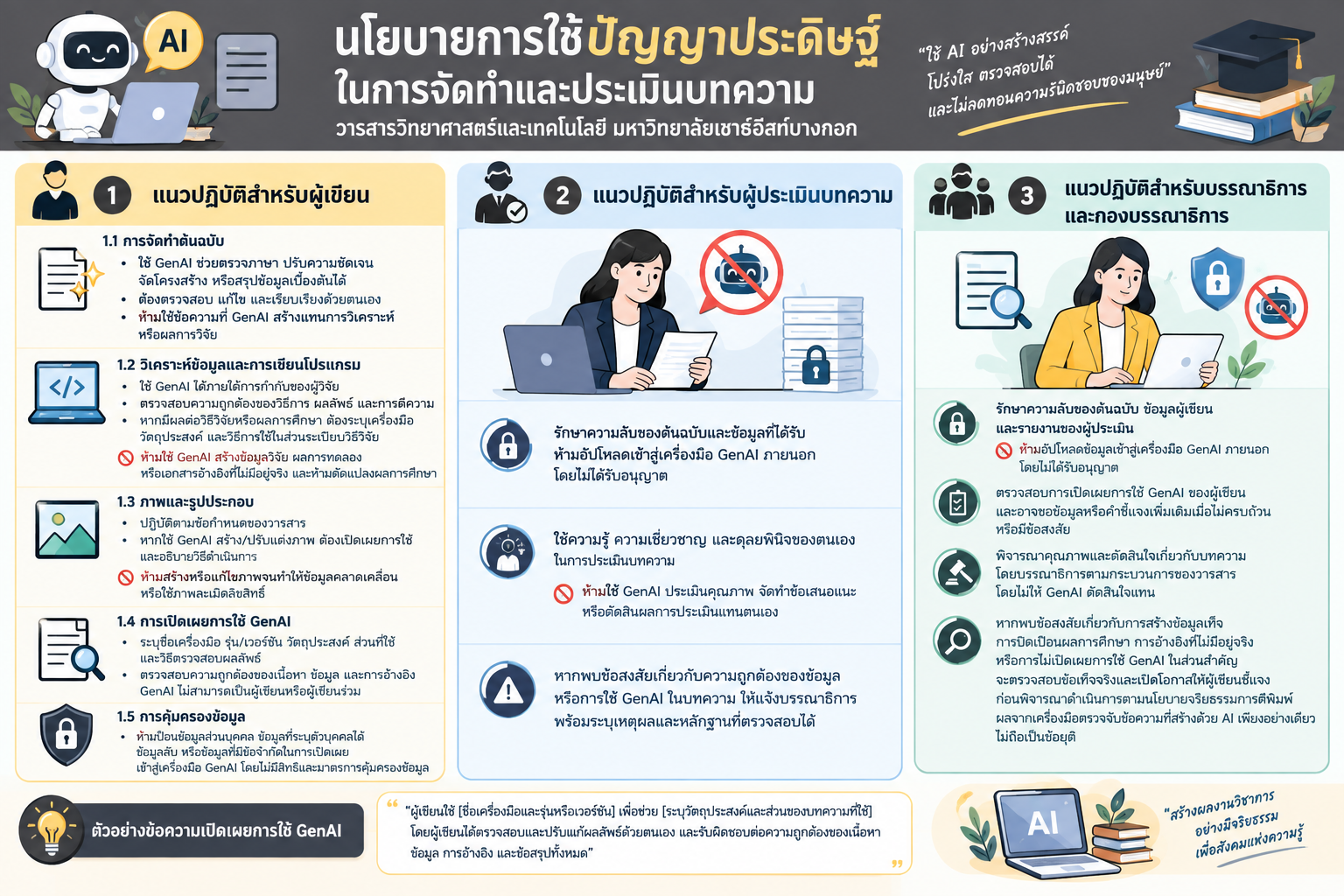
1. Guidelines for Authors
1.1 Manuscript Preparation
Authors may use GenAI to assist with language editing, improving clarity, organizing the structure of the manuscript, or summarizing preliminary information. However, authors must independently verify, revise, and refine the generated content. Authors must not use AI-generated text as a substitute for their own analysis, discussion of findings, or presentation of research findings without appropriate verification.
1.2 Data Analysis and Programming
Authors may use GenAI to support programming or data analysis under the supervision and responsibility of the researchers. Authors must independently verify the accuracy of the research methods, results, and interpretations. If the use of GenAI affects the research methodology or study results, authors must disclose the tool used, its purpose, and the manner in which it was used in the Methodology section in sufficient detail to allow verification.
Authors must not use GenAI to fabricate research data, experimental results, analytical results, or nonexistent references. GenAI must not be used to alter research findings in a manner that misrepresents the actual data.
1.3 Images and Illustrations
Authors must comply with the Journal's requirements regarding the preparation and use of images and illustrations. If GenAI is used to generate or modify images presented in the manuscript, such use must be disclosed and the method of use must be described in the relevant section.
Authors must not use GenAI to create or modify images in a manner that misrepresents research data, create images as substitutes for experiments or results that did not actually occur, or use images in violation of copyright or the rights of others.
1.4 Disclosure of the Use of GenAI
Authors must disclose the use of GenAI both at the manuscript submission stage and in the manuscript itself. The disclosure should specify the name of the tool, model or version where known, purpose of use, sections of the manuscript in which it was used, and the methods employed to verify the generated output, particularly when GenAI is used in relation to literature summarization, research methodology, data analysis, or the preparation of images and illustrations.
Authors must verify the accuracy of all content, data, and references before submitting the manuscript. GenAI tools cannot be listed as an author or co-author, and all authors remain fully responsible for the entire manuscript.
Example of a GenAI Disclosure Statement
The authors used [name of tool and model or version] to assist with [specify the purpose and section(s) of the manuscript in which the tool was used]. The authors independently reviewed and revised the generated output and take full responsibility for the accuracy of the content, data, references, and conclusions presented in the manuscript.
The GenAI disclosure statement should be placed under the heading “Disclosure of the Use of Artificial Intelligence” immediately before the References section. If GenAI forms part of the research methodology, details of its use must also be provided in the Methodology section.
1.5 Data Protection
Authors must not enter personal data, personally identifiable information, confidential information, or information subject to disclosure restrictions into GenAI tools without appropriate authorization and data protection measures.
2. Guidelines for Reviewers
Reviewers must maintain the confidentiality of manuscripts and information received during the review process. Reviewers must not upload manuscripts, supporting materials, or review reports to external GenAI tools without authorization from the Editorial Board.
Reviewers must rely on their own knowledge, expertise, and professional judgment when evaluating manuscripts. GenAI must not be used to evaluate the quality of a manuscript, generate review comments, or make review decisions on behalf of the reviewer. If reviewers have concerns regarding the accuracy of information or the use of GenAI in a manuscript, they should notify the editor and provide reasons and verifiable evidence.
3. Guidelines for Editors and the Editorial Board
Editors and the Editorial Board must maintain the confidentiality of manuscripts, author information, and reviewers' reports. They must not upload such information to external GenAI tools without authorization and appropriate data protection measures.
The Editorial Board is responsible for reviewing authors' disclosures regarding the use of GenAI and may request additional information or clarification when the disclosure is incomplete or concerns arise. The evaluation of manuscript quality and editorial decisions must be made by the editors in accordance with the Journal's established procedures, without allowing GenAI to make decisions on their behalf.
If concerns arise regarding the fabrication of data, manipulation of research findings, nonexistent references, or failure to disclose the use of GenAI in a substantive part of the work, the Editorial Board will investigate the matter and provide the authors with an opportunity to respond before considering further action in accordance with the Journal's publication ethics policy. Results from AI-generated text detection tools alone shall not be considered conclusive evidence in making such determinations.
This policy applies to manuscripts submitted for consideration from Volume 7, Issue 1 (2027) onward.
